


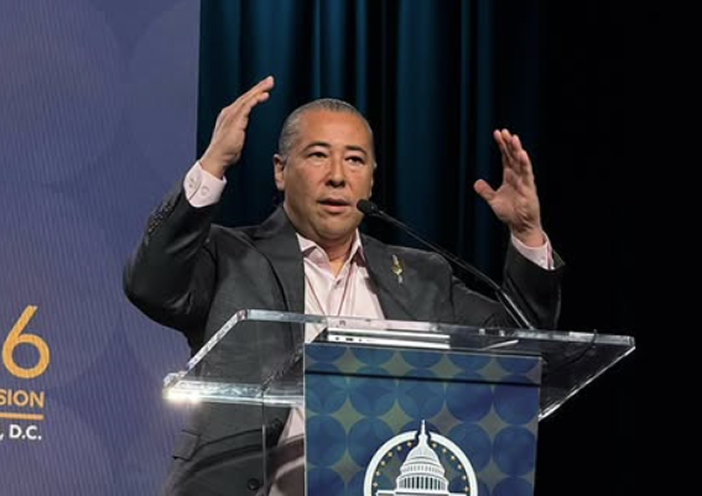
The Indian Gaming Association (IGA) has warned tribal leaders and business stakeholders that illegal prediction markets are becoming an urgent threat to tribal sovereignty and the long-term stability of tribal gaming. The warning was delivered during the Reservation Economic Summit (RES) 2026. This event was hosted by the National Center for American Indian Enterprise Development at Caesars Palace.
Bean Calls Prediction Markets a Sovereignty Crisis
IGA Chairman David Z. Bean said event-based contracts resembling sports betting are expanding rapidly. Furthermore, they could undermine the regulatory framework established under the Indian Gaming Regulatory Act (IGRA). While noting that tribal gaming remains a cornerstone of economic self-sufficiency, Bean argued the industry is now facing one of its most serious challenges in years.
“Indian gaming remains strong, and it continues to be a cornerstone of economic self-sufficiency for tribal nations,” Bean said. “But strength does not mean we are without challenges. Today, we are facing one of the most serious threats to tribal sovereignty in recent history.”
CFTC Accused of Allowing Backdoor Sports Betting
Bean criticised the Commodity Futures Trading Commission (CFTC), claiming it has allowed entities to offer prediction market contracts for more than a year in a way that bypasses tribal and state gambling regulation. He described the situation as federal overreach. In addition, he warned that it could open the door to unregulated gambling nationwide.
“This is federal overreach at its worst,” Bean said. “The CFTC is effectively opening the door to unregulated gambling in every state and on every reservation, disregarding tribal law, state law, and the economic systems we have built to support our communities.”
Tribal Gaming Revenue Funds Essential Services
Bean stressed that tribal gaming differs fundamentally from commercial gambling, noting that gaming revenue supports housing, healthcare, education, and other public services. Additionally, he argued that prediction markets operating outside established gaming law threaten not only regulation, but also the economic foundation supporting tribal communities.
“Our gaming operations are governmental,” Bean said. “The revenues fund housing, healthcare, education, and critical services for our people.”
Outreach Expands as IGA Urges Immediate Action
Bean said the IGA has intensified outreach over the past six months. The group has engaged with more than a dozen tribal organizations and hundreds of tribes to raise awareness of the issue. He urged tribal leaders to respond early. Otherwise, it may be too late, as prediction markets could begin affecting revenue and operations.
“We are telling our leaders, do not wait until this impacts your operations or your bottom line. The time to act is now,” he said.
IGA Pushes Congress for Enforcement
The association is also bringing the issue to Washington. IGA is calling on lawmakers to ensure the CFTC enforces its existing rules. Additionally, they want to prevent prediction markets from being used as a pathway to legalise gambling nationwide.
“We are taking this fight directly to Congress,” Bean said. “We are urging lawmakers to ensure the CFTC enforces its own rules.”
Tradeshow Sessions Planned on Prediction Markets
Bean invited attendees to continue discussions at the upcoming Indian Gaming Tradeshow & Convention in San Diego. There, dedicated sessions will focus on prediction markets and legal developments. He described the issue as non-partisan and urged unity across tribal communities.
“This is not a partisan issue; it is a sovereignty issue,” Bean said, adding that collective action will be essential to protect tribal gaming for future generations.
