



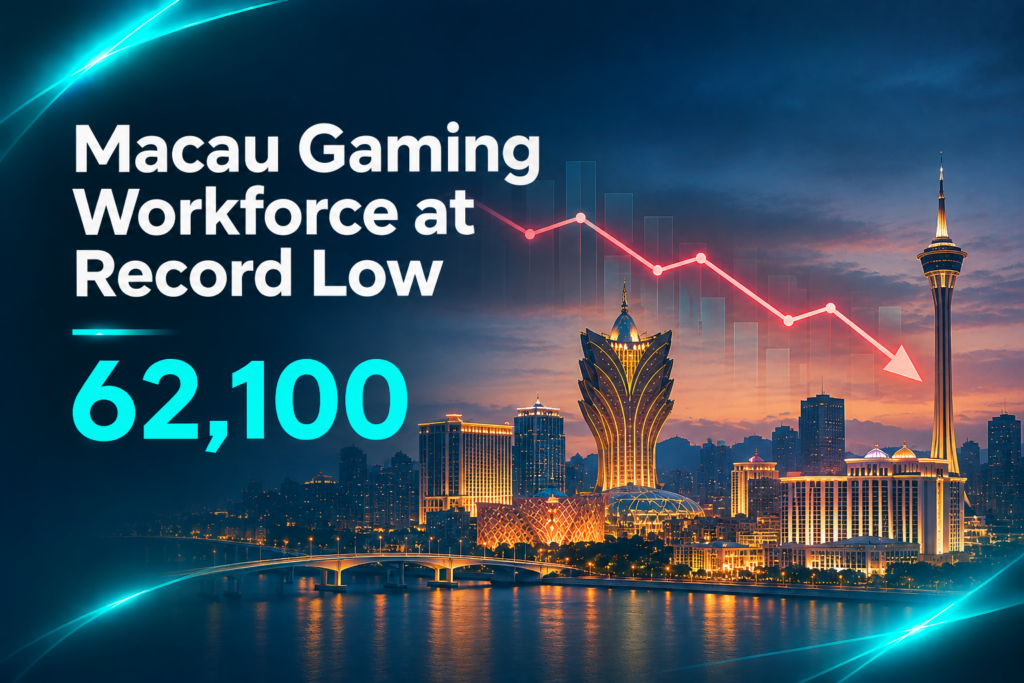
Macau’s resident gaming workforce fell to 62,100 in Q3 2026, the lowest level since DSEC began its quarterly employment series in Q1 2013, according to data confirmed by multiple industry outlets. The figure represents a decline of 3,800 workers (5.8%) since Q1, with two consecutive quarterly drops, against a backdrop of gaming gross gaming revenue (GGR) falling 10% year-on-year for a fifth straight month in October.
The satellite casino phase-out completed at the end of 2025 is the most significant structural change to Macau’s gaming market since the 2002 concession framework, but DSEC data does not isolate its contribution to the headcount decline from natural attrition and retirement.
Key Takeaways
- Macau’s resident gaming workforce reached 62,100 in Q3 2026, down 5.8% from Q1, the lowest since DSEC’s series began in 2013; gaming now accounts for 21.7% of local employment, down from 23% at the start of the year.
- Median monthly earnings for resident gaming workers dropped 12% to MOP 22,000 since Q1’s MOP 25,000, while full-time salaries rose 4.6% year-on-year in Q2, pointing to a shift away from lower-paid dealer roles.
- October GGR fell 10% YoY to MOP 21.68 billion, roughly 18% below 2019 pre-pandemic levels, for the fifth consecutive monthly decline, even as non-gaming visitor spending rose 13.3%.
Core Employment and Revenue Data
| Metric | Q1 2026 | Q2 2026 | Q3 2026 | Change (Q1→Q3) |
|---|---|---|---|---|
| Resident gaming workers | 65,900 | 63,200 | 62,100 | −3,800 (−5.8%) |
| Gaming share of local employment | 23.0% | — | 21.7% | −1.3 pp |
| Median gaming worker pay (MOP) | 25,000 | 22,000 | 22,000 | −12% |
| Gaming-background job seekers among unemployed | 13.3% | 14.4% | 19.5% | +6.2 pp |
October GGR stood at MOP 21.68 billion, down 10% YoY and approximately 18% below 2019 levels, per Bloomberg and Investing.com. The decline matched analysts’ median forecast, indicating sustained revenue softness rather than an isolated shock.
Where the Contraction Is Concentrated
A significant pay movement is a key signal. Median earnings for resident gaming workers fell from MOP 25,000 in Q1 to MOP 22,000 in Q2 and Q3, a 12% drop. In contrast, average full-time gaming salaries rose 4.6% year-on-year in Q2, while dealer wages increased only 1.5%. This divergence suggests operators are retaining experienced full-time staff while reducing hourly or part-time roles, a pattern that could reshape demand for staffing and training services over coming quarters.
However, DSEC’s survey does not track what happened to workers displaced by the satellite closure. A June 2025 government estimate placed roughly 5,600 local residents in satellite casinos, of whom about 4,800 worked through gaming concessionaires. The extent to which that group contributed to the 3,800-worker decline remains unconfirmed. Lower headcounts can also result from retirement and natural attrition.
The unemployment picture adds nuance. Macau’s resident unemployment rate eased 0.2 percentage points to 2.3% in Q3, with 6,800 residents unemployed. Yet the share of those job seekers with prior gaming experience rose from 13.3% in Q1 to 19.5% in Q3. This does not confirm a direct link between the gaming workforce decline and overall unemployment. The 19.5% figure describes the background of all unemployed job seekers, not the gaming sector’s own unemployment rate, per Gambleballers’ clarification.
Revenue and Diversification Context
The October GGR decline, at roughly 18% below 2019 levels, may constrain operator capital expenditure, a key driver of B2B supplier revenue in land-based gaming. The Macau Economic Association noted in early 2026 that gaming growth momentum was moderating and the recovery uneven, with large enterprises performing well while SMEs faced operational pressure.
Meanwhile, non-gaming visitor spending rose 13.3% in Q3, signalling continued diversification. If that trend deepens, it could gradually shift Macau’s economic demand away from pure gaming hardware toward hospitality, MICE, and entertainment, though the impact on specific supplier categories remains unmeasured.
Open Questions and Disputed Comparisons
Two unresolved issues define the trajectory. First, DSEC does not track where displaced workers went, so the labour market cannot yet confirm whether the contraction is being absorbed into other sectors or persisting as unemployment. Second, the year-on-year comparison is disputed: Yogonet cited a 9.9% decline against 68,900 a year earlier, while AG Brief used 64,300 (a 3.4% decline), and the discrepancy remains unresolved across sources.
A sustained pace of 1,100 to 1,700 workers per quarter could bring resident gaming employment toward 60,000 by year-end, but this is a projection, not a confirmed outcome.
FAQ
What does “resident gaming workforce” mean in DSEC’s data?
It refers to Macau’s local (resident) employees working in the gaming sector, excluding non-resident workers. DSEC has tracked this figure quarterly since Q1 2013.
Is the workforce decline caused by the satellite casino closure?
The satellite phase-out at end-2025 is a likely contributing factor, but DSEC does not isolate its impact from natural attrition, retirement, or other operational adjustments. The government previously stated it would oversee job-matching and vocational training for affected satellite casino employees.
How does the 19.5% gaming-background figure relate to gaming unemployment?
It represents the share of all unemployed job seekers who have prior gaming experience, not the gaming sector’s own unemployment rate. It indicates that a meaningful portion of displaced workers did not find immediate re-employment, but it does not confirm how many left gaming entirely.
Sources
- yogonet.com
- macaudailytimes.com.mo
- gambleballers.com
- agbrief.com
- bloomberg.com
- au.finance.yahoo.com
- focusgn.com
