


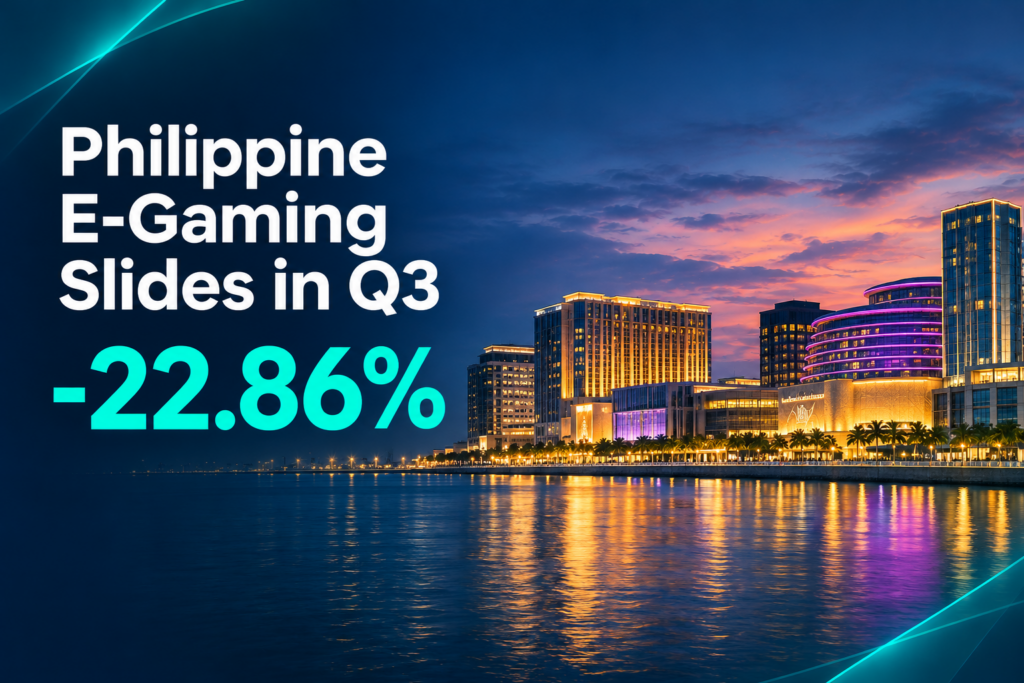
PAGCOR’s official Q3 2026 figures confirm that Philippine industry gross gaming revenue fell 11.41% year-on-year to PHP83.72 billion, down from PHP94.51 billion in Q3 2025. The contraction was overwhelmingly concentrated in the e-gaming segment, which dropped 22.86% and accounted for roughly 97% of the total quarterly GGR decline, while licensed land-based casinos slipped just 0.40%.
Chairman Alejandro Tengco attributed the weaker result to inflation and geopolitical uncertainty affecting consumer confidence and discretionary spending. Notably, PAGCOR did not cite regulatory tightening, market saturation, or competitive shifts as drivers.
Key Takeaways
- E-gaming’s 22.86% Q3 decline (to PHP35.28 billion) drove 97% of the PHP10.79 billion total GGR gap, while licensed casinos fell only 0.40%, reasserting land-based dominance at 54.20% of total GGR versus e-gaming’s 42.10%.
- The sequential 2026 trajectory—Q1 –16%, Q2 –20.33%, Q3 –11.41%—shows the decline accelerated before easing.
- PAGCOR’s conservative full-year 2026 GGR target of at least PHP350 billion implies roughly a 12% decline from 2025’s PHP396 billion, consistent with the Q1–Q3 cumulative performance.
Why E-Gaming, Not Casinos, Drove the Q3 Contraction
The Q3 2026 data reveals a stark divergence between the two revenue pillars of Philippine gaming.
| Segment | Q3 2025 GGR | Q3 2026 GGR | YoY Change |
|---|---|---|---|
| Total industry | PHP94.51B | PHP83.72B | –11.41% |
| E-gaming (e-games, e-bingo, bingo) | PHP45.73B | PHP35.28B | –22.86% |
| Licensed commercial casinos | PHP45.56B | PHP45.38B | –0.40% |
E-gaming had overtaken land-based casinos as the larger revenue segment in Q1 2025, when GGR surged 27% to PHP104.1 billion. By Q3 2026, the balance had reversed: land-based licensees, including Entertainment City integrated resorts, captured 54.20% of GGR versus e-gaming’s 42.10%. Casino Filipino posted PHP3.03 billion in Q3, down 4.81%, contributing about 3.6% of total.
This reversal matters for B2B partners because it indicates the decline is segment-specific rather than a broad consumer-demand collapse. Integrated-resort and land-based operator contracts appear stable, while the online segment absorbed nearly the entire contraction.
A Narrowing Decline, But an Unconfirmed Recovery
The sequential 2026 path is non-linear: Q1 GGR fell 16%, Q2 deepened to 20.33%, and Q3 narrowed to 11.41%. PAGCOR framed the Q3 improvement as encouraging, but the absolute level remains sharply negative.
The inflection point was not Q1 2026. The 2025 full-year GGR rose 6.39% to PHP396 billion, but Q4 2025 already fell 18.65%, marking the start of the current downturn cycle. Tengco’s attribution to inflation and geopolitical uncertainty—rather than regulatory action or licensing changes—suggests a macro-driven adjustment. This distinction affects recovery timing: if the pressure is economic rather than policy-driven, the recovery horizon depends on broader consumer-confidence indicators rather than regulatory milestones.
PAGCOR’s own nine-month e-gaming income fell 37%, a different period and measure from the Q3 industry data, but a sign of pressure on the regulator’s revenue. PAGCOR has also been weighing a sale of Casino Filipino branches amid mounting losses. These signals point to financial stress at the state-operator level, which could affect license-fee structures, regulatory capacity, and the pace of new e-gaming approvals, though no specific policy changes have been announced.
Implications for Philippine Market Revenue Forecasting
For content providers, platform operators, and game aggregators with Philippine e-gaming exposure, the data supports several recalibrations:
- Downward revision of 2026 online-segment revenue forecasts is warranted given the 22.86% Q3 decline and 37% nine-month PAGCOR e-gaming income drop, indicating pressure has not yet stabilised at the operator level.
- Product and content investment may need to shift toward land-based and integrated-resort channels, where the 0.40% decline is effectively flat and revenue share has regained dominance.
- Diversified exposure is protective. Partners with both online and land-based contracts should outperform pure-online players, given the sharp segment divergence.
PAGCOR’s full-year target of at least PHP350 billion implies roughly a 12% decline from 2025. If the Q3 trajectory persists, actual full-year GGR may land near or below that threshold. Q4 2026 remains the key variable: whether seasonal patterns can offset the cumulative Q1–Q3 shortfall, or whether the macro pressures Tengco cited continue to suppress discretionary spending.
FAQ
What caused the Philippine e-gaming revenue decline in Q3 2026?
PAGCOR Chairman Tengco attributed the 22.86% e-gaming GGR drop to inflation and geopolitical uncertainty affecting consumer confidence and discretionary spending. The official data does not cite regulatory tightening, market saturation, or competitive shifts as drivers.
How does the e-gaming decline compare to land-based casino performance in Q3 2026?
E-gaming GGR fell 22.86% to PHP35.28 billion, while licensed commercial casinos slipped only 0.40% to PHP45.38 billion. Land-based casinos accounted for 54.20% of total GGR versus e-gaming’s 42.10%, reversing the Q1 2025 crossover.
What is PAGCOR’s full-year 2026 GGR target and does it align with the Q1–Q3 trajectory?
PAGCOR set a conservative target of at least PHP350 billion for full-year 2026, implying roughly a 12% decline from 2025’s PHP396 billion. This is consistent with the cumulative Q1–Q3 performance, though Q4 results have not yet been reported.
