



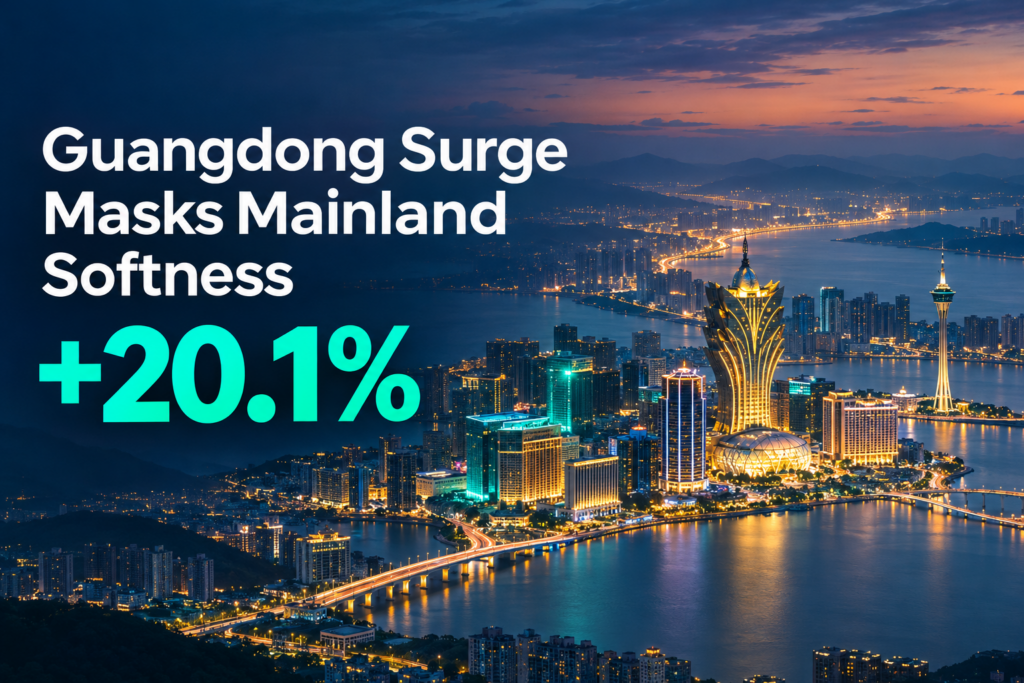
Macau visitor arrivals rose 10.1% year-on-year to 3,823,243 in October 2026, according to official data from the Statistics and Census Service (DSEC). The headline figure, however, conceals a sharply uneven source-market picture: visitors from Guangdong province surged 20.1% YoY, while arrivals from all other mainland Chinese feeder markets declined 1.0%, and international visitors fell 4.3% to 249,714.
Key Takeaways
- Guangdong’s 20.1% YoY visitor surge drove mainland China arrivals to 2,833,998 (+11.8%), but non-Guangdong mainland markets declined 1.0%, indicating concentrated rather than broad-based growth.
- International arrivals dropped 4.3% YoY to 249,714, with the Philippines (-19.7%), Indonesia (-16.3%), and South Korea (-21.4%) posting sharp declines.
- Average length of stay fell 0.1 day to 1.0 day, and same-day visitors (+14.8%) outpaced overnight growth (+2.9%), pointing toward a shift in trip composition.
The October 2026 Visitor Snapshot
The following table summarises DSEC figures for October 2026 as reported by GGRAsia, Macau Business, Trading Economics, and FocusGN:
| Segment | Oct 2026 | YoY Change |
|---|---|---|
| Total arrivals | 3,823,243 | +10.1% |
| Mainland China | 2,833,998 | +11.8% |
| Guangdong province | — | +20.1% |
| Other mainland markets | — | -1.0% |
| IVS visitors | 1,561,281 | +18.1% |
| Same-day visitors | 2,414,299 | +14.8% |
| Overnight visitors | 1,408,944 | +2.9% |
| Avg. length of stay | 1.0 day | -0.1 day |
| International | 249,714 | -4.3% |
| Hong Kong | 644,741 | +10.3% |
Arrivals for the first 10 months of 2026 reached 36,004,515, up 8.6% YoY.
Guangdong’s 20% Surge Against a Broader Mainland Decline
The single most significant feature of October’s data is the split within mainland China. Guangdong, Macau’s largest provincial source by volume, grew 20.1% YoY, while every other mainland feeder market combined registered a 1.0% decline. The Individual Visit Scheme (IVS) visitor count rose 18.1% to 1,561,281, outpacing the overall mainland growth of 11.8%, which may reflect Guangdong’s role as a core IVS province, though DSEC did not publish a provincial IVS breakdown.
This divergence suggests that the mainland recovery is not broad-based. Rather than a general easing of demand across Chinese provinces, the data suggest a corridor-specific effect concentrated in the Guangdong–Macau link. However, DSEC did not attribute the 20.1% increase to any specific cause, and no confirmed policy, transport, or promotional change has been identified as the driver.
Hong Kong arrivals rose 10.3% to 644,741, adding modest volume, but not enough to offset the softness in the wider mainland base.
International and Overnight Weakness Beneath the Headline
The 10.1% headline growth masks two structural concerns for operators. First, international arrivals fell 4.3% to 249,714, dragged by sharp declines in Southeast Asia, Northeast Asia, and South Asia. The Philippines (-19.7%), Indonesia (-16.3%), and South Korea (-21.4%) all posted double-digit drops, indicating that Macau’s international source base is contracting rather than recovering.
Second, the composition of visitors is shifting. Same-day visitors grew 14.8% to 2,414,299, while overnight visitors rose only 2.9% to 1,408,944. The average length of stay fell 0.1 day to 1.0. This pattern, if sustained, points toward more impulse and short-trip tourism with lower per-visitor revenue potential compared with overnight or multi-day stays, though the October data does not include per-capita GGR by source province to confirm the revenue impact.
What Remains Unknown
Several questions are material for B2B partners assessing Macau’s source-market trajectory but cannot be answered from the current data:
- Per-capita spending by source province: DSEC visitor figures do not break out gaming revenue or per-capita GGR by origin. Without that split, it is unclear whether the incremental Guangdong visitors are high-yield or lower-spending same-day guests.
- Sustainability of the Guangdong surge: Whether the 20.1% gain reflects a one-off policy or transport stimulus, a seasonal pattern, or a durable structural shift cannot yet be determined from a single month.
- International recovery timeline: Further months of double-digit declines in key Asian markets would strengthen the case for structural weakness rather than a one-month dip. October is, for now, a single data point.
Operators and their marketing, technology, and platform partners should treat the October split as a signal to monitor source-market concentration rather than as confirmation of a new revenue equilibrium. The 10.1% headline growth, while positive in aggregate, is not broadly based and may not translate proportionally into gaming revenue if the incremental traffic is skewed toward shorter, lower-yield trips.
FAQ
Why did Guangdong visitors surge while other mainland markets declined?
DSEC published the 20.1% Guangdong increase and the 1.0% decline in other mainland markets but did not attribute the divergence to a specific cause. The gap may reflect corridor-specific factors, but no confirmed policy, transport, or promotional change has been identified.
Which international markets showed the largest declines in October 2026?
South Korea fell 21.4%, the Philippines 19.7%, and Indonesia 16.3% YoY. Collectively, international arrivals dropped 4.3% to 249,714, with declines concentrated in Southeast Asia, Northeast Asia, and South Asia.
What does the fall in average length of stay mean for operators?
The average stay dropped 0.1 day to 1.0, and same-day visitors (+14.8%) outpaced overnight growth (+2.9%). If this pattern persists, it signals a shift toward shorter, potentially lower-yield trips, though the October data does not include per-capita GGR by source to confirm the revenue impact.
